Importance
Where Slips Start: Mapping the Highest-Risk Zones in Your Barn
By Rick Jr. · May 8, 2025
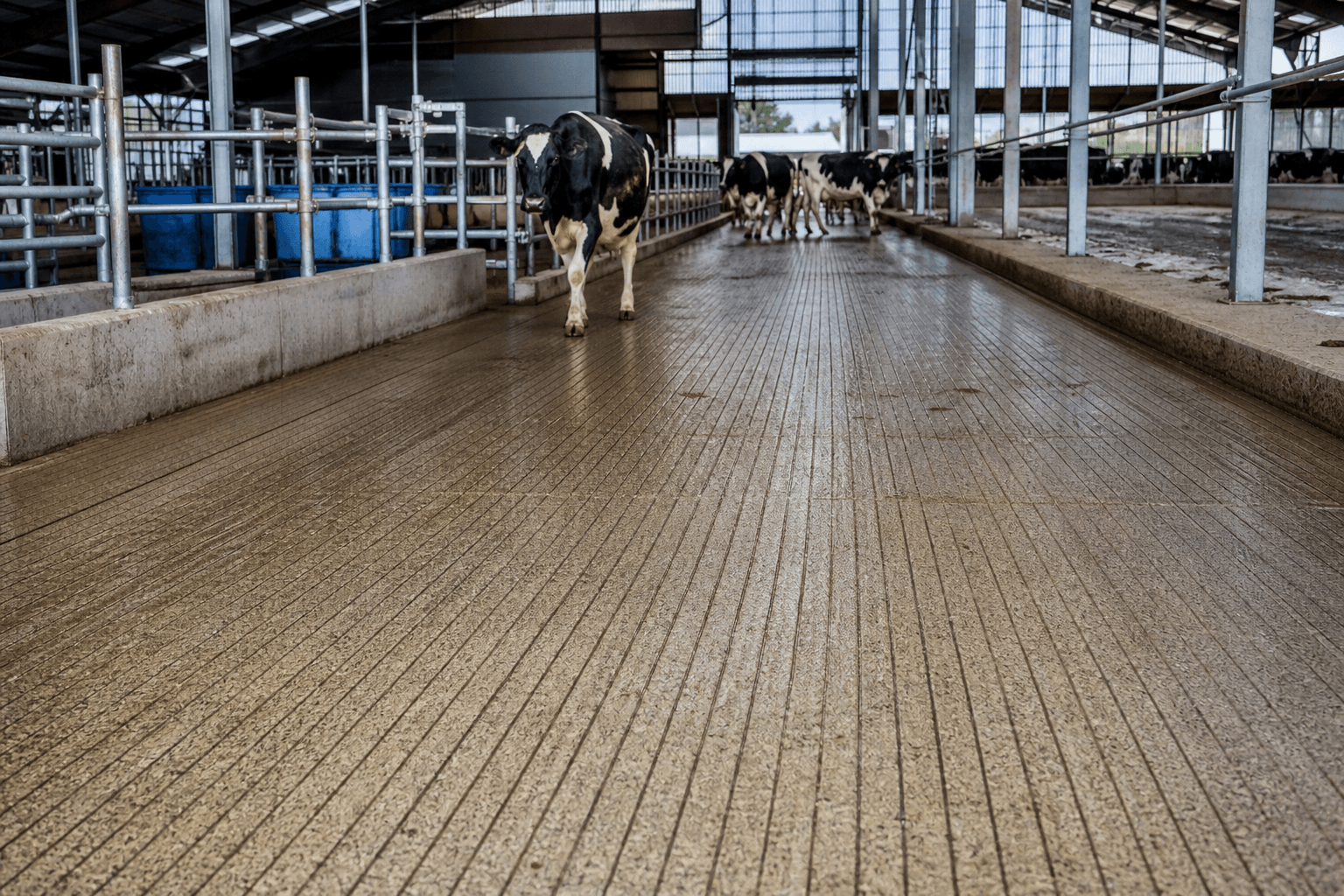
Diagram of high-risk dairy barn zones including holding area parlor return and turn areas needing grooving
Not every foot of concrete fails the same way. Knowing where cows slip most — holding areas, returns, turns — lets you prioritize grooving where it prevents lameness fastest.
Every Barn Has a Weak Link
Walk into most dairies and the alleys look fine. Cows move, milk gets harvested, the day goes on. But every barn I've evaluated in 35+ years of grooving has at least two or three zones where the floor is lying to you — looks okay from the office, fails cows at shift change when manure film and crowding combine.
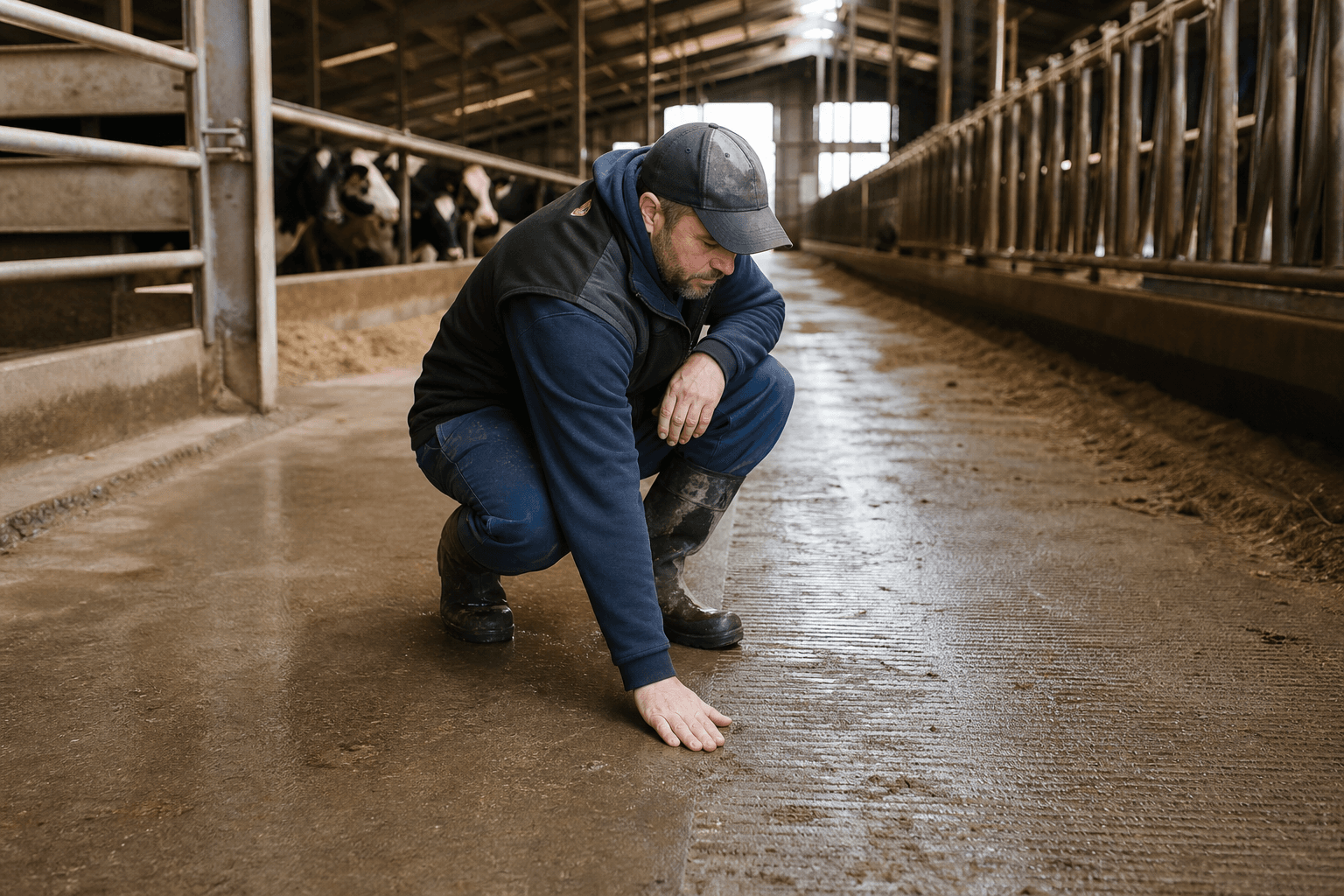
Mapping those zones before you cut saves money and stops lameness faster than grooving blind. You don't need fancy equipment — rubber boots, milking time, and honest observation tell you more than any floor rating scale. Watch where cows hesitate. That's your map.
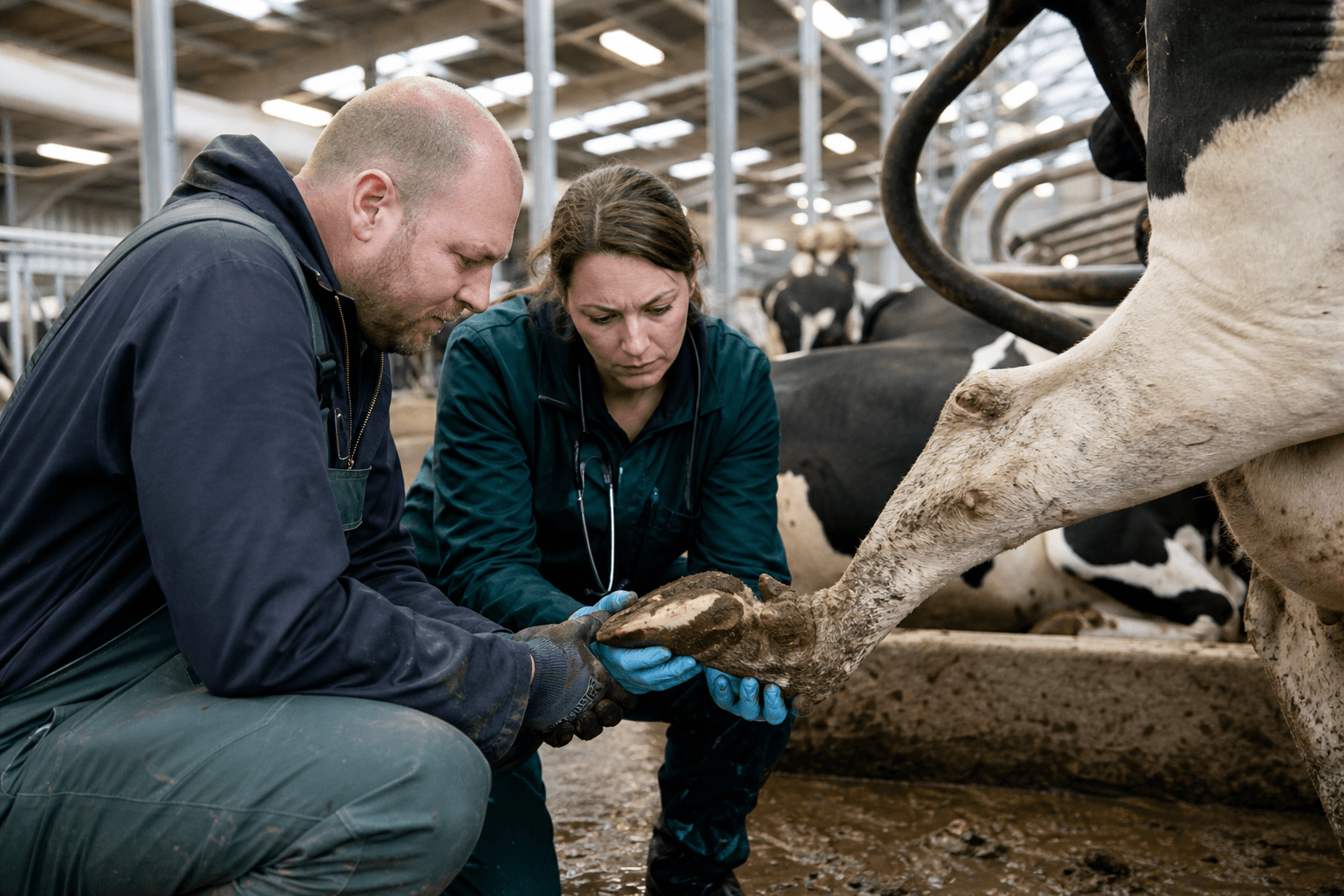
Lameness from slips costs about $4.50 per day per lame cow, with 700–900 lbs of milk lost per case and treatment running $76–$533. Lameness ranks as the #3 cost on a dairy farm. Fixing the right zones first gives you the biggest return on grooving at roughly $0.75/sq ft.
Watch where cows hesitate at shift change. That's your map.
Holding Areas: Packed Cows, Zero Margin
The holding area is where slip problems show up loudest. Cows stand tight, shift weight, push neighbors, and wait on concrete that's often the slickest in the barn because it sees the most manure and wash water without the scraping alleys get.
A cow that slips in the holding area doesn't just hurt herself — she falls into other cows and creates a chain reaction. I've seen single holding-area incidents drive a month's worth of hoof trimmer callbacks. If you groove nothing else first, groove here.
Our holding and parlor grooving service targets these high-density zones with patterns that handle standing traffic and pivot points. See why grooving works for the spacing standards that keep hooves safe in tight quarters.
Parlor Returns and Alley Transitions
Cows exit the parlor with momentum. They hit the return lane ready to walk back to free stalls — and if that lane is smooth, they scramble. The scramble is where toe ulcers start. Return lanes see more acceleration and deceleration per square foot than almost anywhere else in the barn.
Transitions matter too: where the return meets the cross alley, where alleys widen into sorting areas, where a step or slope changes elevation. Each transition is a slip point if the concrete isn't grooved or if grooves wore smooth on the approach.
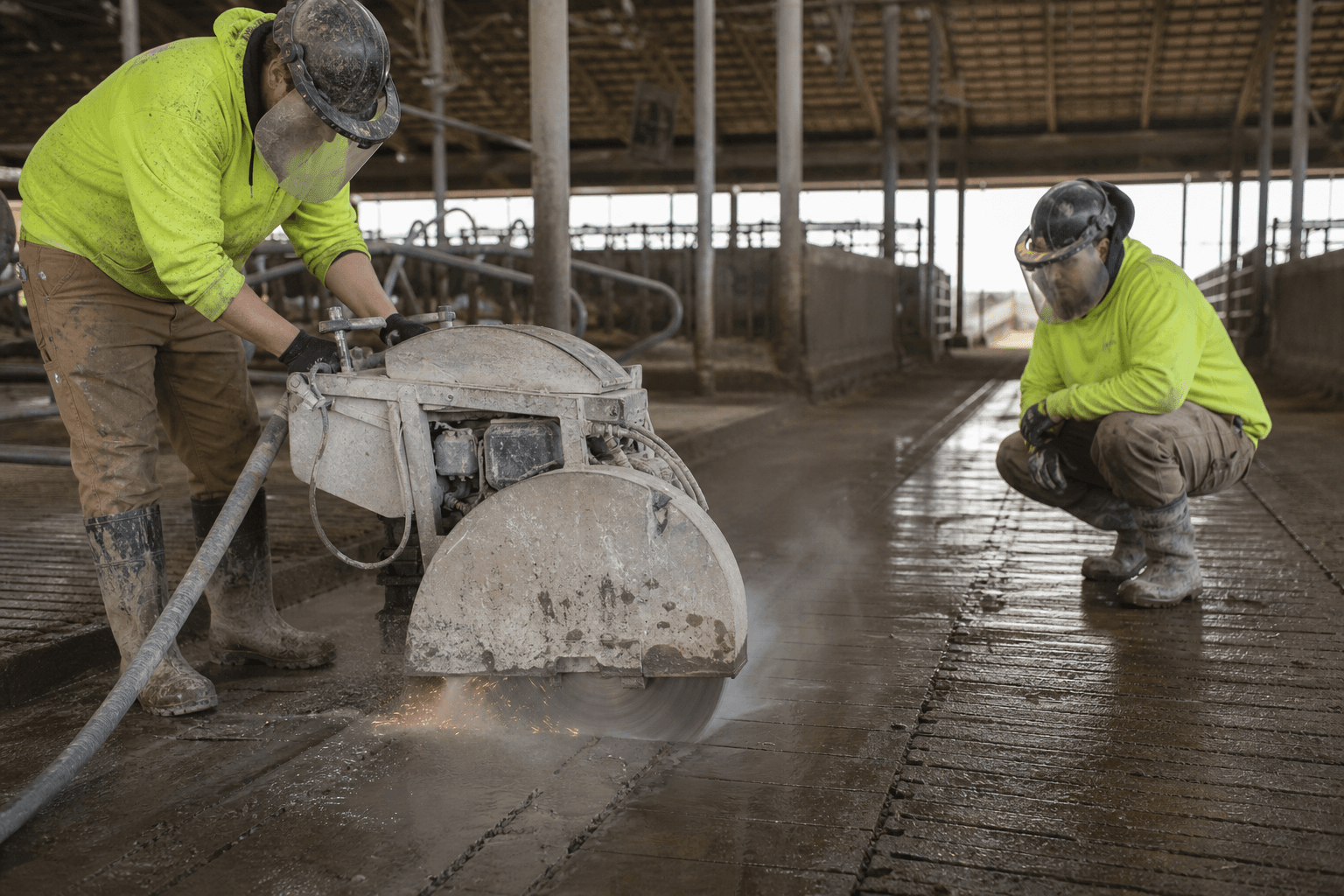
Diamond patterns at turns and straight-line grooves on long returns are the standard combination. Our grooving patterns page shows how we match cut type to traffic. Don't assume one pattern fits the whole barn.
Free Stalls, Waterers, and Feed Alleys
Free stall rows see cows standing, lying, and rising against rear curbs. That push-off happens on concrete. Slick row floors mean every stand-up is a small slip risk repeated dozens of times per day per cow.
Waterers and feed bunk approaches concentrate traffic. Cows stop, pivot, and jockey for position. Turn areas without proper grooving — or with grooves worn round after six years — are lameness factories that fly under the radar because nobody stands there watching all day.
When budget limits how much you cut in one pass, prioritize waterers, bunk ends, and stall rows after holding and returns. Phase the rest on the 6–8 year plan rather than skipping zones entirely.
Scraper paths matter. Automatic scrapers polish alleys in their wheel tracks while leaving ridges and slick strips between passes. Grooving the full alley width — not just center lines — prevents the uneven wear pattern that catches hooves where scraper coverage is inconsistent.
Ramps, Doorways, and Outdoor Transitions
Any slope is a slip multiplier. Barnyard ramps, load-out alleys, and door thresholds where indoor meets outdoor concrete see weather, mud tracked in, and cows moving at angles. Herringbone or cross-hatch patterns on ramps give grip that straight lines can't on a grade.
Outdoor concrete weathers differently — freeze-thaw roughens the surface until spring, then polished wear takes over. Don't ignore barnyards because cows spend less time there. One bad ramp incident can lame a cow as thoroughly as a holding-area fall.
Compare long-term options on grooving vs milling before choosing a surface treatment for outdoor work. Square-edged grooving handles ramps and yards with patterns designed for the traffic type.
Loading chutes and treatment alleys see stressed cattle and handler pressure — cows that jump and spin on slick surfaces. Groove these zones even if they're small. One chute incident can cost more than grooving the entire chute twice over.
One bad ramp incident can lame a cow as thoroughly as a holding-area fall.
From Map to Action Plan
Walk your barn at the worst time — mid-milking, wet floor, full holding area. Mark slip zones with chalk or photos. Match your trimmer's lameness records to those zones. The overlap is your priority list for grooving or regrooving.
If your barn was last cut seven or eight years ago, assume edges are rounding everywhere — but stress zones fail first. Regrooving restores square edges at about $0.75/sq ft without replacing the slab. Request a free estimate and we'll walk the zones with you.
Keep your herd on all fours by fixing the floor where cows actually slip — not where it's convenient to run the saw. Davidson Cement Grooving, 35+ years nationwide. Let's map your barn.
Seasonal Patterns in Slip Risk
Slip rates climb in wet seasons — spring thaw, humid summers, fall rains tracked in on boots and tires. Winter brings frozen manure ridges that hide slick patches underneath. Zone mapping isn't a one-time exercise. Re-walk your barn each season and note where conditions change.
Holding areas worsen when group sizes swell during high-production periods. Return lanes suffer when milker staffing runs tight and cows exit in bursts. Your risk map should account for how the barn actually runs at peak, not how it looks on a quiet afternoon.
Groove the zones that fail under peak stress first. Maintain them on the 6–8 year regroove cycle. Compare approaches on grooving vs milling if a contractor recommends a shortcut for a specific zone — the wrong profile in the holding area costs more than any travel fee you saved.
New barn additions create new slip zones at the seams — where old concrete meets new, where a expanded holding area feeds into an ungrooved return, where a retrofitted parlor sends cows onto alleys that weren't in the original grooving plan. Map transitions every time you renovate, not just when the whole barn was last cut.
Night shift sees different traffic than day shift if grouping changes. Walk the barn during both if you run split shifts. The zone that looks fine at noon may fail at 4 a.m. when cows are tired, floors are wetter, and staffing is thin. Your grooving priority list should reflect worst-case conditions, not average afternoons.
Map first, cut second. Every grooving job we do starts with boots on the floor — not a quote from satellite photos.
Contractors who skip the walk-through miss the zones that lame cows. We don't quote blind, and you shouldn't buy blind either.
Every barn layout is different — crossover alleys, drive-through feed lanes, robotic fetch pens. Generic grooving maps miss the custom friction points your cows navigate daily. Walk first, then cut.
Robotic barns still have fetch lanes and crossover alleys where cows move on concrete. Autonomous milking didn't eliminate footing stress — it changed where it concentrates. Map those paths before lameness clusters where the robot brings cows twice a day.
Zone mapping takes an hour. Lameness from missed zones costs years. Bring the hoof trimmer on the walk if they'll come — they'll point at the corners you overlooked.
Frequently Asked Questions
Can we groove high-priority zones first and do the rest later?
Yes. Many farms phase grooving by risk zone — holding areas and returns first, then alleys and free stalls. We recommend a plan that covers the full barn within a reasonable window so partial grooving doesn't leave new weak links.
How do I know if existing grooves are worn out in specific zones?
Run your boot across the groove edge. If it feels rounded instead of sharp, grip is compromised. Watch cows at shift change in that zone — hesitation and scrambling mean edges are failing even if grooves still look visible.
Do outdoor barnyards need different grooving patterns?
Ramps and sloped areas typically use herringbone or cross-hatch patterns for grip on grade. Flat barnyards may use straight-line or diamond cuts depending on traffic. We evaluate each surface based on how cows use it.